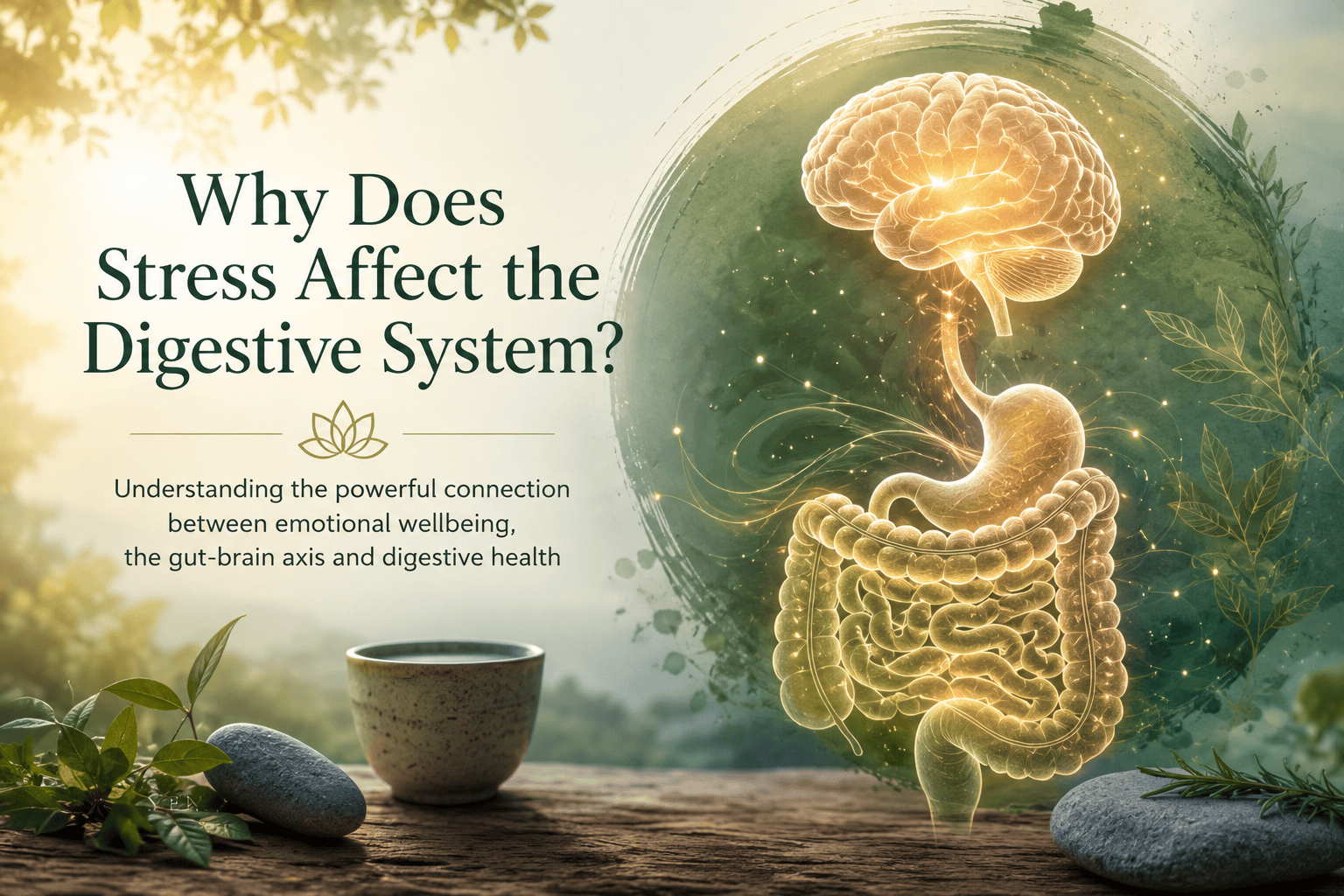
Why does stress affect the digestive system? Few physical symptoms create as much frustration and confusion as digestive problems. Unlike an injury that can be seen or an illness that can be clearly identified through obvious physical signs, digestive disturbances often seem unpredictable and inconsistent. A particular meal may cause discomfort one day and appear completely harmless the next. Some individuals experience persistent bloating despite maintaining a healthy diet, while others develop food intolerances that seem to emerge without warning.
Many people spend years experimenting with different nutritional plans, eliminating entire food groups and taking countless supplements, only to discover that their symptoms continue to fluctuate regardless of what they eat. Eventually, a question begins to emerge, and it is one that has become increasingly common in recent years: why does stress affect the digestive system?
The answer lies in one of the most remarkable relationships within the human body. The digestive system and the brain are engaged in a constant and extraordinarily sophisticated conversation that influences virtually every aspect of our physical and emotional wellbeing. For many years, medicine treated the digestive system as a largely mechanical process in which food entered the body, nutrients were extracted and waste products were eliminated. While this description is technically correct, it fails to acknowledge the immense complexity of a system that responds not only to food but also to our emotions, our thoughts, our memories and our psychological experiences.
Most people have experienced the physical consequences of emotional distress at some point in their lives. Anxiety creates butterflies in the stomach. Fear produces nausea. Grief suppresses the appetite. Excitement may cause digestive discomfort, while prolonged emotional tension often creates a persistent feeling of tightness within the abdomen.
These reactions occur so quickly that they are frequently dismissed as temporary inconveniences, yet they reveal something extraordinarily important about the way the human body functions. The digestive system is not simply responsible for processing food. It is also one of the most emotionally responsive systems within the body.
Modern neuroscience has provided overwhelming evidence supporting the existence of what researchers call the gut-brain axis, a communication network that links the central nervous system to the gastrointestinal tract through a complex combination of hormones, nerves, neurotransmitters and immune responses. This communication occurs continuously, regardless of whether we are consciously aware of it, and it influences everything from digestion and nutrient absorption to inflammation and emotional regulation.
Although this relationship has become a major focus of contemporary research, the concept itself is far from new. Traditional healing systems recognised thousands of years ago that emotions profoundly influence physical health. Traditional Chinese Medicine, for example, has always viewed emotional wellbeing and digestive health as inseparable. According to this philosophy, excessive worry, overthinking and prolonged emotional strain interfere with the normal flow of energy throughout the body and can contribute to digestive imbalance. While contemporary medicine uses a different conceptual framework, it is fascinating to observe how modern scientific discoveries often echo principles that have existed for centuries.
Throughout my work in psychology, holistic health and therapeutic practice, I have repeatedly encountered people whose digestive symptoms appeared to worsen during periods of emotional stress. Some developed persistent bloating. Others experienced constipation, abdominal discomfort or chronic indigestion. Many complained of profound fatigue after meals, while others noticed that their appetites disappeared entirely whenever they experienced emotional difficulties. What made these cases particularly interesting was that dietary changes alone rarely provided complete relief because food was only one component of a much larger picture.
To understand why this occurs, we must first examine the body’s survival response. Human beings evolved in an environment in which immediate physical dangers represented a constant threat. Survival depended upon the body’s ability to respond quickly and efficiently to potentially life-threatening situations. Consequently, the nervous system developed a remarkably sophisticated defence mechanism commonly known as the fight-or-flight response.
When the brain detects danger, a cascade of physiological changes occurs almost instantaneously. Adrenaline and cortisol are released into the bloodstream, heart rate increases, blood pressure rises and muscles prepare for action. The body redirects its resources towards systems that are essential for survival, while temporarily reducing energy expenditure in areas considered less important during an emergency.
Digestion is one of the first processes to be affected.
From an evolutionary perspective, this response makes perfect sense. If our ancestors had been confronted by a dangerous animal, continuing to digest lunch would have been considerably less important than escaping from an immediate threat. Blood flow was therefore redirected away from the digestive organs towards the muscles and the cardiovascular system, allowing the body to prioritise survival.
The problem, of course, is that modern stress rarely resembles the acute, short-lived dangers for which this biological response was designed. Instead of running from a predator for a few minutes before returning to a state of safety, we may spend months coping with financial difficulties, caring for elderly relatives, struggling with relationship problems, worrying about our health or attempting to manage increasingly demanding professional responsibilities. The nervous system remains activated for prolonged periods, and the digestive system pays a significant price.


Chronic stress affects virtually every stage of the digestive process. The production of stomach acid may become altered, digestive enzymes may become less effective and intestinal motility may become disrupted. In some individuals, food moves too slowly through the digestive tract, contributing to constipation and abdominal discomfort. In others, digestion accelerates, leading to diarrhoea and intestinal irritation. Many people experience bloating because stress influences both digestion and the composition of the intestinal microbiome.
The microbiome has become one of the most fascinating areas of modern medical research. Trillions of microorganisms inhabit the digestive tract, forming a complex ecosystem that influences digestion, immunity, metabolism and even emotional wellbeing. Scientists have discovered that chronic stress can alter the composition of these microbial communities, reducing diversity and contributing to inflammatory processes that may affect both physical and psychological health.
Perhaps one of the most surprising discoveries in recent years is that the digestive system contains an enormous network of neurons known as the enteric nervous system. This network is so extensive that researchers have occasionally referred to it as the body’s second brain. Although the digestive system does not think in the same way as the central nervous system, it possesses an extraordinary capacity for independent regulation and constant communication with the brain.
The vagus nerve plays a particularly important role in this communication. Extending from the brain to multiple organs throughout the body, it serves as a major communication pathway between the central nervous system and the digestive tract. Signals travel continuously along this pathway, carrying information in both directions. The brain influences digestive activity, while the digestive system simultaneously sends information back to the brain regarding inflammation, nutrient status, microbial activity and physiological balance.
This bidirectional communication explains why digestive disorders are frequently associated with emotional disturbances such as anxiety and depression. It also explains why emotional distress can produce immediate physical symptoms within the abdomen. The relationship between psychological wellbeing and digestive health is not theoretical. It is biological, measurable and extraordinarily complex.
One particularly interesting aspect of this relationship involves serotonin, a neurotransmitter commonly associated with emotional regulation. Many people are surprised to learn that a significant proportion of the body’s serotonin is produced within the digestive tract. Although serotonin is often discussed in the context of mood disorders, it also plays an essential role in regulating intestinal function. This helps explain why disruptions in digestive health frequently coincide with changes in emotional wellbeing and why chronic stress can have such profound effects on both the mind and the body.
In my book Unlock the Power Within, I discuss the importance of recognising the interconnected nature of human health. One of the greatest mistakes we make is assuming that emotional experiences and physical symptoms exist independently of one another. Human beings cannot be divided into separate categories because every thought creates physiological changes, every emotional experience produces biological responses and every physical symptom influences our psychological state.
Perhaps nowhere is this more evident than in our relationship with food.
Modern eating habits have become increasingly disconnected from the body’s natural rhythms. Meals are often consumed in a state of distraction, breakfast is frequently skipped and many people eat while working, driving or scrolling through their mobile phones. Food has become another task to complete rather than an opportunity for nourishment and restoration.
The digestive system functions most efficiently when the parasympathetic nervous system, often referred to as the rest-and-digest state, is fully activated. Unfortunately, many individuals eat while remaining physiologically trapped within the fight-or-flight response. Under these circumstances, digestion becomes compromised because the body never receives the message that it is safe to relax.
This may explain why so many people experience overwhelming fatigue after meals. Digestion requires enormous amounts of energy, and when stress simultaneously interferes with blood sugar regulation, hormonal balance and nutrient absorption, exhaustion frequently follows. Individuals often assume that their symptoms are caused exclusively by specific foods, when emotional stress may actually represent a significant contributing factor.
Appetite itself is profoundly influenced by emotional wellbeing. Some people lose all interest in food during stressful periods, while others develop powerful cravings for sugar, refined carbohydrates or highly processed foods. Neither response should be considered abnormal because stress directly affects hormones responsible for regulating appetite, metabolism and reward pathways within the brain.
Emotional eating deserves particular attention because it illustrates the intimate relationship between food and psychological wellbeing. Food is not simply fuel. It also represents comfort, celebration, connection and security. During periods of emotional distress, eating may temporarily relieve anxiety or provide a brief sense of pleasure. Unfortunately, this often creates a cycle in which emotional discomfort leads to unhealthy eating habits, which then contribute to digestive symptoms and further emotional distress.

Breaking this cycle requires a more comprehensive understanding of health. Dietary interventions may certainly be beneficial, but nutrition alone rarely addresses the entire problem. Emotional wellbeing, sleep quality, physical activity, stress management and self-awareness are equally important components of digestive health.
Meditation can play a particularly valuable role because it encourages nervous system regulation and promotes a state of physiological relaxation. Numerous studies suggest that mindfulness practices can reduce cortisol levels, improve emotional resilience and alleviate certain digestive symptoms. Meditation does not eliminate life’s challenges, but it changes the way we respond to them, allowing the body to shift away from chronic physiological activation and towards restoration and recovery.
Massage therapy may also provide significant benefits. Throughout my years as a holistic therapist, I have often observed how emotional tension manifests physically within the abdominal region. Therapeutic touch promotes relaxation, reduces muscular tension and activates the parasympathetic nervous system, creating conditions that support both physical and emotional healing.
Nature represents another frequently overlooked therapeutic resource. Spending time outdoors has been associated with lower stress hormone levels, improved mood and enhanced nervous system regulation. Modern life exposes us to constant stimulation, endless information and persistent distractions, all of which contribute to chronic stress. Nature offers an opportunity to slow down, breathe deeply and reconnect with ourselves in ways that support both emotional wellbeing and digestive health.
Perhaps one of the most important lessons we can learn is that symptoms are not always random. The body communicates continuously, and the digestive system is often one of its most articulate messengers. This does not mean that every digestive disorder has an emotional origin, nor should persistent symptoms ever be dismissed without appropriate medical evaluation. Gastrointestinal diseases require proper diagnosis and treatment, and physical symptoms should always be taken seriously.
However, it would be equally unwise to ignore the emotional dimension of digestive health.
When people ask why stress affects the digestive system, they are often searching for something far more profound than a biological explanation. They are trying to understand why their bodies no longer feel familiar. They are attempting to make sense of symptoms that seem disconnected from food itself. They are wondering whether their exhaustion, bloating, discomfort or digestive disturbances might reflect emotional burdens that have remained unresolved for far too long.
Increasingly, both science and traditional healing practices suggest that this possibility deserves serious consideration. The digestive system does far more than process nutrients because it continuously interprets and responds to our internal world. Our thoughts, emotions and experiences leave physiological traces throughout the body, and the digestive system frequently reflects those influences with remarkable sensitivity.
Perhaps healing begins when we stop asking what is wrong with the body and begin asking what the body might be trying to tell us. In many cases, the answer lies not only in what we eat, but also in how we live, how we think, how we manage stress and how we care for ourselves emotionally. Understanding this extraordinary relationship does not provide instant solutions, but it does offer something equally valuable: an opportunity to approach our health with greater awareness, greater compassion and a deeper appreciation for the inseparable connection between emotional wellbeing and digestive health.
Venerina Conti is a psychology graduate, holistic health therapist, Reiki Master and author of Unlock the Power Within, From Victim to Victory, From Depression to Power, From Addiction to Freedom and From Stuck to Free. Her work explores the relationship between psychology, emotional healing, the nervous system and personal transformation.
For further reading:
Why do we store emotions in the body?