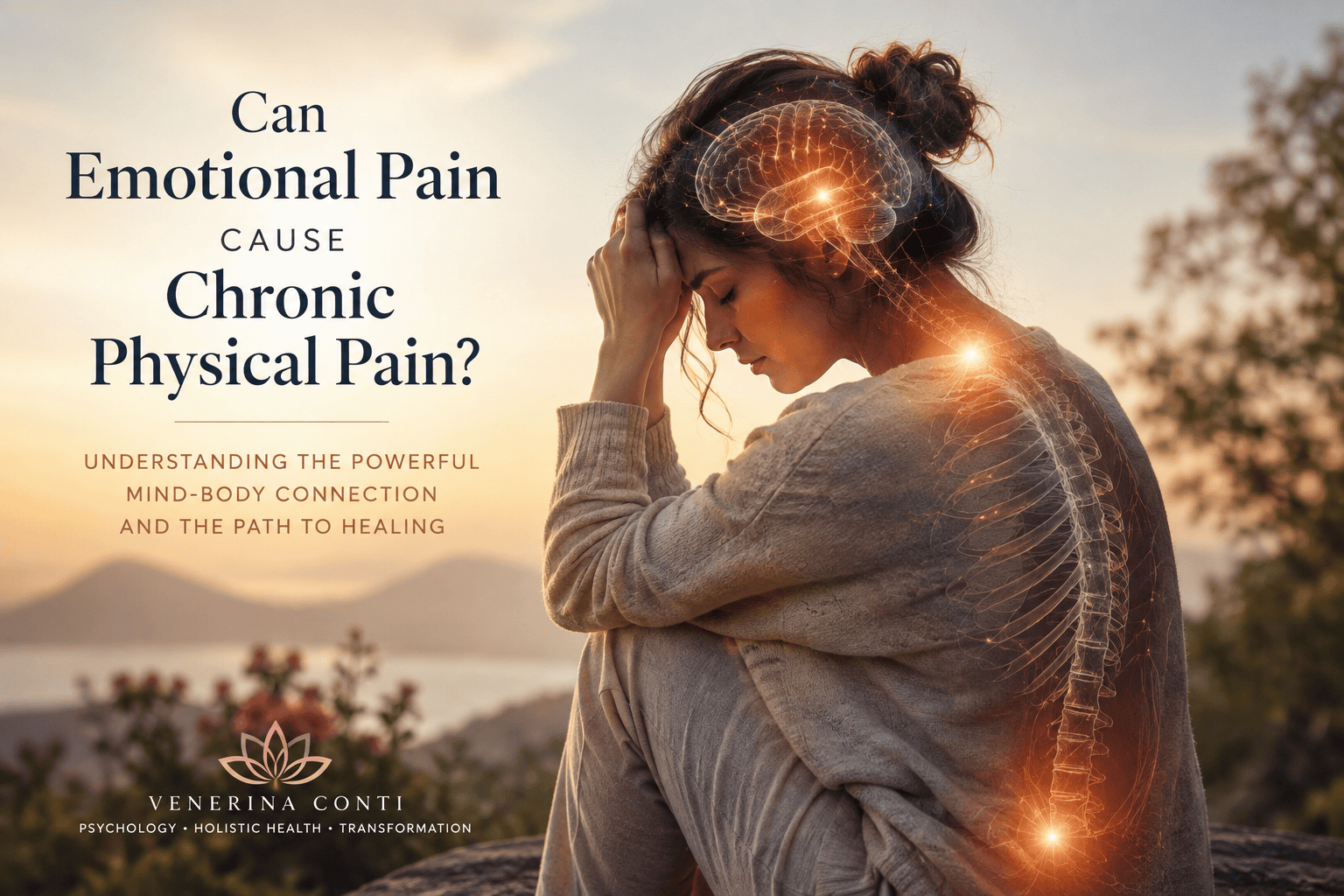
One of the most fascinating questions in psychology and holistic health is whether emotional pain can eventually manifest as chronic physical pain. It is a question that has generated considerable debate among physicians, psychologists, neuroscientists and traditional healing practitioners for decades, yet it is also a question that most people have already answered through their own lived experience.
Anyone who has experienced profound grief understands that emotional suffering is not confined to the mind. Anyone who has lived through prolonged anxiety knows that worry can affect digestion, breathing and sleep. Anyone who has experienced heartbreak recognises that emotional pain can feel physically overwhelming. We speak about carrying the weight of the world on our shoulders, feeling sick with worry, having a knot in our stomach or suffering from a broken heart because human beings have always understood, at least intuitively, that our emotional and physical experiences are inseparable.
For many years, conventional medicine approached the mind and the body as two distinct entities. Physical symptoms were treated separately from emotional experiences, and specialists concentrated on increasingly narrow areas of expertise. Although this approach undoubtedly contributed to extraordinary advances in medicine, it also created an artificial division that often failed to acknowledge the complexity of human health.
Contemporary research is gradually moving away from this reductionist perspective. Neuroscience, psychoneuroimmunology, behavioural medicine and trauma research increasingly recognise that thoughts, emotions, hormones, the nervous system and physical health are continuously interacting with one another. This does not mean that every physical illness originates in the mind, nor does it suggest that chronic pain should be dismissed as a psychological phenomenon. However, it does indicate that emotional suffering may contribute to biological changes capable of influencing the development, intensity and persistence of physical symptoms.
Throughout my work in psychology, holistic health and mind-body therapies, I have repeatedly encountered individuals who spent years searching for exclusively physical explanations for symptoms that seemed resistant to every intervention. They consulted specialists, underwent numerous examinations and followed a variety of treatment protocols, yet their discomfort remained unchanged. Understandably, many became frustrated because medical investigations frequently failed to provide clear answers. Their pain was real, their exhaustion was real and their suffering was undeniable, yet something important appeared to be missing from the conversation. Very often, the missing component was an exploration of emotional wellbeing.
In my book Unlock the Power Within, I discuss the importance of recognising the profound relationship between our thoughts, emotions and physical health. One of the central themes of the book is that meaningful transformation requires us to view ourselves as integrated human beings rather than as collections of unrelated symptoms. The body does not function independently from the mind, and the mind does not operate in isolation from the body. Every emotional experience creates physiological changes, and every physiological response influences our emotional state. Health emerges from a continuous dialogue between these two dimensions of our experience.
Stress provides one of the clearest examples of this relationship. When we perceive a threat, our bodies initiate a remarkably sophisticated survival response. Hormones such as cortisol and adrenaline are released, heart rate increases, blood pressure rises and muscles prepare for action. These responses developed to help our ancestors survive immediate dangers. Once the threat disappeared, the body returned to equilibrium and normal functioning resumed. Modern life, however, has transformed stress into a chronic rather than an acute experience. Instead of confronting a temporary danger, we may spend months or even years coping with financial concerns, relationship difficulties, professional responsibilities, emotional loss or persistent uncertainty.

The human body was never designed to remain in a permanent state of physiological activation. When stress becomes chronic, the consequences extend far beyond emotional discomfort. Cortisol levels may remain elevated, inflammatory processes may increase, sleep patterns may become disrupted and the immune system may become compromised. Digestion frequently changes, energy levels decline and muscles remain contracted for prolonged periods. Over time, these physiological adaptations may contribute to the development of chronic symptoms, including persistent pain.
One of the most significant discoveries in modern neuroscience is that emotional pain and physical pain share some of the same neurological pathways. Brain imaging studies have demonstrated that experiences such as social rejection, grief and emotional loss activate regions of the brain that are also involved in processing physical pain. This finding does not imply that emotional suffering and physical injury are identical experiences, but it does suggest that the distinction between them is far less clear than previously believed. The brain does not always separate emotional distress from physical discomfort as neatly as traditional models once suggested.
Traditional healing systems reached similar conclusions thousands of years ago, although they used a different vocabulary to describe these processes. Traditional Chinese Medicine, for example, has long proposed that emotions influence the movement of energy throughout the body and that unresolved emotional experiences may eventually contribute to physical imbalance. According to this philosophy, particular emotional states are associated with specific organ systems and patterns of energy flow. Although contemporary science may not interpret these concepts in exactly the same way, both perspectives acknowledge that emotions exert a measurable influence on physical health.
My experience as a therapist has repeatedly reinforced this understanding. During massage treatments, I have often observed patterns of muscular tension that appear to reflect much more than simple physical overexertion. Many clients carry extraordinary amounts of tension in their shoulders, neck and jaw, while others experience persistent discomfort in the lower back or abdominal region. It would be simplistic and irresponsible to suggest that every area of muscular tension corresponds directly to a specific emotional experience, yet it would be equally misguided to ignore the possibility that our bodies may reflect aspects of our emotional lives.
The shoulders frequently become symbolic repositories for responsibility and stress. Individuals who spend years caring for others often develop chronic muscular tension in this region. The jaw commonly reflects anxiety and emotional restraint. The abdomen responds quickly to fear and uncertainty because the digestive system is extraordinarily sensitive to emotional influences. Again, these observations should never replace medical assessment or diagnosis, but they encourage us to approach pain with curiosity rather than limitation.
Trauma offers perhaps the most compelling example of the relationship between emotional suffering and physical symptoms. Contemporary trauma research has demonstrated that overwhelming experiences may continue to influence the nervous system long after the original events have ended. Unresolved trauma can alter physiological responses, increase sensitivity to stress and affect emotional regulation. Individuals who have experienced significant trauma frequently report symptoms such as chronic pain, fatigue, digestive disturbances, headaches and sleep disorders. The body often retains memories that the conscious mind has attempted to suppress or avoid.
This concept has received increasing attention within both scientific literature and therapeutic practice because it challenges the traditional assumption that the passage of time alone is sufficient to promote healing. Emotional wounds do not automatically disappear because years have passed. Experiences that remain unresolved may continue to shape physiology, behaviour and perception long after the original circumstances have changed.
One of the greatest challenges associated with chronic pain is that it often creates a self-perpetuating cycle. Physical discomfort contributes to emotional distress, while emotional distress intensifies physical symptoms. Pain increases anxiety, anxiety heightens pain perception and both interfere with sleep. Sleep deprivation reduces emotional resilience, increases inflammation and lowers the threshold for discomfort. Gradually, individuals become trapped within a cycle in which physical and emotional suffering continuously reinforce one another.
This understanding highlights the importance of adopting a more comprehensive approach to health. Chronic pain rarely responds to simplistic solutions because it rarely has a single cause. Genetics, physical injury, inflammation, hormonal changes, lifestyle factors, emotional stress and environmental influences may all contribute simultaneously. Attempting to isolate one factor while ignoring all the others may prevent us from developing a complete understanding of the problem.
This is one of the reasons why I have always advocated for an integrative model of wellbeing. Medication may be beneficial in certain circumstances. Physiotherapy may play an essential role in restoring movement and function. Psychological support may help individuals develop healthier coping strategies. Nutritional interventions may reduce inflammation and improve metabolic health. Exercise may strengthen the body and improve mobility. Massage may reduce muscular tension and promote relaxation. Meditation may support emotional regulation and alter pain perception. None of these approaches should be viewed as mutually exclusive because healing is rarely achieved through a single intervention.
Meditation, in particular, has attracted considerable scientific interest in recent years. Numerous studies suggest that mindfulness practices may reduce stress, improve emotional regulation and influence the way the brain processes pain. Meditation does not eliminate physical symptoms, nor does it require us to deny the reality of suffering. Instead, it teaches us to observe our experiences differently. It encourages awareness, acceptance and the development of a more compassionate relationship with ourselves.
Nature may also play an important therapeutic role. Spending time outdoors has been associated with reductions in stress hormones, improvements in mood and enhanced psychological wellbeing. Throughout my work, I have repeatedly observed how silence, introspection and natural environments can create opportunities for emotional healing that are often difficult to achieve within the pressures of everyday life. When we remove ourselves from constant stimulation and allow ourselves time for reflection, we frequently begin to recognise emotional patterns that have remained invisible for years.
In Unlock the Power Within, I emphasise the importance of self-awareness because awareness represents the foundation of transformation. We cannot change what we refuse to acknowledge, and we cannot heal what we fail to recognise. This principle applies equally to our emotional lives and our physical health. Pain may sometimes serve as an invitation to explore dimensions of our experience that we have neglected or ignored.
Many people resist this exploration because they associate emotional vulnerability with weakness. They continue to function despite exhaustion, suppress their emotions and place the needs of others above their own. Eventually, the body begins to communicate in increasingly powerful ways. Persistent fatigue demands rest. Insomnia demands change. Chronic tension demands attention. Physical symptoms often become impossible to ignore precisely because they represent messages that have remained unheard for far too long.
It is important to emphasise that chronic pain should never be automatically attributed to emotional causes. Persistent symptoms always require appropriate medical evaluation because numerous physical conditions demand professional diagnosis and treatment. However, acknowledging the emotional dimension of health does not diminish the legitimacy of physical suffering. On the contrary, it expands our understanding of it.
Perhaps the most meaningful question is not whether emotional pain can cause chronic physical pain, but whether we are prepared to examine every possible contributor to our wellbeing. Human beings are remarkably complex. Our experiences, relationships, beliefs, memories, behaviours and environments all shape our health in ways that science is only beginning to understand fully.

The outdated division between the mind and the body is gradually disappearing because evidence increasingly supports what many traditional healing systems have always maintained: emotional and physical wellbeing are inseparable. Every thought influences physiology, every emotion creates biological responses and every physical experience affects our psychological state. Health cannot be reduced to isolated symptoms because human beings cannot be reduced to isolated systems.
Can emotional pain cause chronic physical pain? For many individuals, the answer appears to be yes. Yet perhaps the most hopeful aspect of this relationship is that healing also appears to function in both directions. If emotional suffering can contribute to physical symptoms, then emotional healing may also support physical recovery.
This possibility invites us to approach our health with greater compassion, greater curiosity and a deeper appreciation for the extraordinary connection between the mind and the body. Sometimes, the path towards healing begins not with another medical investigation or another treatment protocol, but with the willingness to ask ourselves what experiences, emotions and burdens we may have been carrying for far too long, and whether our bodies have been trying to tell us something all along.
Venerina Conti is a psychology graduate, holistic health therapist, Reiki Master and author of Unlock the Power Within, From Victim to Victory, From Depression to Power, From Addiction to Freedom and From Stuck to Free. Her work explores the relationship between psychology, emotional healing, the nervous system and personal transformation.
For further reading: