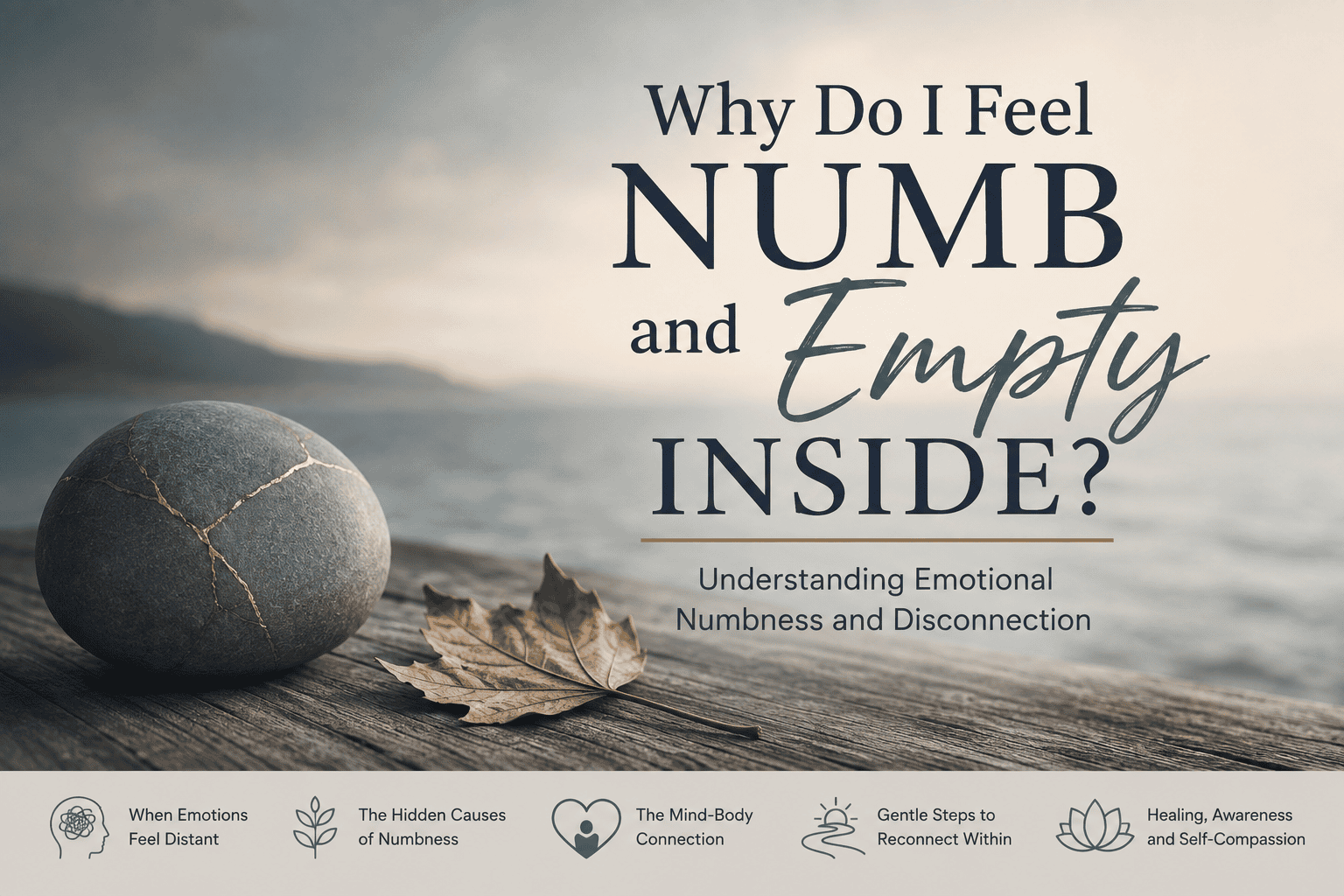
Why do I feel numb inside? – There are times in life when people expect themselves to feel something. Yet they discover that they cannot. They may know they should be sad about a loss. They may be angry about how they have been treated or excited about an opportunity. But emotionally there appears to be very little happening at all. They may feel disconnected. They may be going through the motions of life without truly participating in it. From the outside, they may continue working, caring for others, socialising and fulfilling their responsibilities. Internally, they feel strangely distant from themselves and from the world around them. This raises a question: Why do I feel numb and empty inside.
For someone who has always thought of themselves as an emotional person, this experience can be particularly frightening. They may begin asking themselves what has happened to them. Have they become cold? Have they stopped caring? Why can they not cry, even when they know they are upset? Why do things that once brought them pleasure no longer seem to affect them in the same way? Why do they feel as though they are watching their own life rather than fully living it?
Emotional numbness is not easy to understand, because it can seem to contradict how we usually think about emotional distress. When we imagine someone who is struggling psychologically, we often picture visible sadness, tears, anxiety, anger, or obvious emotional turmoil. However, emotional overwhelm does not always express itself through an increase in feeling. Sometimes the opposite can happen. When the emotional system has been under pressure for a prolonged period, a person may begin to feel less rather than more. Instead of experiencing intense emotions consciously, they may feel detached from them.

This does not necessarily mean that there is nothing happening beneath the surface. In many cases, emotional numbness may be understood as a protective response. Human beings are remarkably adaptable, and when an experience feels too painful, overwhelming or difficult to process, the mind may find ways of reducing conscious contact with it. This can happen in response to a single traumatic event, but it can also develop gradually through chronic stress, repeated disappointments, emotional suppression, burnout, unresolved grief or years of carrying responsibilities without sufficient opportunity to rest and recover.
The important point is that emotional numbness should not be interpreted in a single way. Feeling numb does not necessarily mean that a person has experienced trauma, nor does it automatically indicate a specific psychological condition. It is an experience rather than a diagnosis, and it can have many contributing factors. Persistent emotional numbness may also occur alongside depression, anxiety, prolonged stress, grief and other mental or physical health concerns, while certain medications and physical health issues can influence emotional experience. This is why someone who feels persistently numb, empty or disconnected should not assume the cause without considering the wider picture.
From a psychological perspective, however, it is useful to understand that emotional disconnection can sometimes develop when feeling everything has simply become too difficult. We all possess a limited capacity for dealing with stress. When life presents us with one challenge after another, we may initially respond by working harder, trying to solve the problem, supporting everyone around us or convincing ourselves that we simply need to keep going. For a while, this may appear to work. The person continues functioning, fulfils their responsibilities and perhaps even receives praise for being strong. The difficulty is that emotions do not necessarily disappear simply because we have decided that we do not have time to deal with them.
When sadness is repeatedly pushed aside, anger is swallowed, fear is ignored and exhaustion is dismissed, the emotional system may eventually begin communicating in other ways. Some people become anxious, irritable or overwhelmed. Others develop physical symptoms associated with chronic stress, including muscular tension, digestive disturbances, headaches and persistent fatigue. Some may experience a gradual emotional shutdown in which they no longer feel fully connected to either painful or pleasurable emotions.
This can be particularly confusing because emotional numbness does not always feel dramatic. In fact, it may initially be experienced as a kind of quiet absence. A person may wake in the morning, complete their usual routine, speak to colleagues, prepare meals and answer messages, yet feel as though there is a sheet of glass between themselves and the rest of the world. They may laugh at the appropriate moments without feeling genuine amusement, tell someone that everything is fine because they no longer know how to explain what is actually happening and continue living according to habit because stopping to examine their feelings seems somehow more difficult than simply continuing.
There is an important difference between choosing emotional calm and experiencing emotional numbness. Meditation, mindfulness and psychological self-awareness can help people develop a healthier relationship with their emotions, allowing them to observe feelings without being completely controlled by them. Emotional numbness, however, is not usually characterised by a sense of peaceful awareness. Instead, it is more likely to involve a feeling of disconnection, absence or detachment. A person may not feel calm because they have learned to regulate their emotions; they may simply feel unable to access them.
One of the reasons this distinction matters is that many people have spent years believing that emotional control means not showing or feeling too much. They may have been raised in families where anger was unacceptable, sadness was viewed as weakness or emotional expression was discouraged. They may have learned from an early age that their role was to be the strong one, the responsible one or the person who looked after everyone else. Over time, emotional suppression can become so habitual that a person loses contact with the feelings they have spent years attempting to control.
This does not mean that everyone who suppresses emotion will eventually become emotionally numb, but the habit of constantly overriding internal experience can create a growing distance between what we genuinely feel and what we allow ourselves to acknowledge. The more often we tell ourselves that something does not matter when it clearly does, the easier it can become to ignore our own emotional signals. Eventually, the problem is not simply that we are hiding our feelings from other people. We may begin hiding them from ourselves.

This is one of the areas in which self-awareness becomes particularly important. Emotional healing does not always begin with finding an immediate solution. Sometimes it begins by becoming curious about what is happening inside us. Rather than asking, “How can I make myself feel normal again?” it can be helpful to begin with questions such as, “When did I start feeling this way?” “What has been happening in my life?” “What emotions have I been avoiding?” “Have I been under prolonged pressure?” and “When was the last time I gave myself permission to simply stop?”
These questions are not designed to produce instant answers. Human emotional experience is rarely that straightforward. Nevertheless, reflection can help us begin recognising patterns that were previously hidden by the speed and demands of everyday life. A person who feels emotionally empty may discover that they have spent years putting everyone else’s needs before their own. Another may realise that their numbness began after a significant loss that they never allowed themselves time to grieve. Someone else may recognise that they have been living under chronic stress for so long that they can no longer remember what it feels like to genuinely relax.
The relationship between emotional experience and the body is also important. The mind and body do not operate as completely separate systems, even though we often speak about them as if they do. Thoughts and emotions influence physiological processes, while physical states can influence mood, energy and emotional resilience. Chronic stress can affect sleep, digestion, muscular tension and the nervous system, and prolonged physical exhaustion can make it more difficult to regulate emotions effectively.
This does not mean that every physical symptom is caused by an emotional problem, nor should physical symptoms ever be dismissed as “all in the mind.” The relationship is more complex than that. Human beings are integrated systems in which psychological and physical processes constantly influence one another. When someone is emotionally overwhelmed, the body may respond. When someone is physically unwell or chronically exhausted, their emotional wellbeing may also suffer. Understanding the mind-body connection should encourage us to consider the whole person rather than assuming that every problem belongs exclusively to either the body or the mind.
In my own work and writing, I have repeatedly explored the importance of becoming aware of the relationship between our thoughts, emotions and physical experience. Emotional healing is not about pretending that difficult feelings do not exist, nor is it about forcing ourselves to remain positive. In fact, the constant pressure to think positively can sometimes become another form of emotional avoidance. If someone feels grief, anger, disappointment or fear, telling themselves that they should simply be grateful or optimistic does not necessarily make the underlying emotion disappear.
Sometimes healing begins by allowing ourselves to acknowledge what is already there. This can be uncomfortable, particularly for people who have spent years avoiding difficult feelings, but emotions often become easier to understand once we stop treating them as enemies. Anger may tell us that a boundary has been crossed. Sadness may reveal the importance of something we have lost. Fear may indicate that we feel unsafe or uncertain. Emotional pain may point towards experiences that require attention rather than suppression.
Emotional numbness can complicate this process because the feelings may no longer be immediately accessible. Someone may know intellectually that they have experienced something painful while feeling almost nothing when they think about it. This does not mean that they are incapable of healing or that their emotions have disappeared permanently. It may simply mean that reconnecting with their internal world requires patience, safety and time.
For some people, talking can be an important part of this process. Speaking with a qualified therapist or counsellor can provide a structured and supportive environment in which thoughts and emotions can be explored without judgement. For others, writing can become a useful way of recognising feelings that are difficult to express aloud. Journalling allows thoughts to emerge without the immediate pressure of explaining them to another person, and sometimes people discover emotions on the page that they had not consciously realised they were carrying.
Mindfulness and meditation can also be valuable when approached gently. The purpose is not to force emotion to appear or to sit in silence until a dramatic breakthrough occurs. Instead, mindfulness can help us become more aware of our present experience, including the fact that we may currently feel disconnected. Even noticing numbness is a form of awareness. We might begin by observing physical sensations, noticing our breathing or becoming aware of the thoughts that appear when we ask ourselves how we are feeling.
Creative expression may also provide another route towards emotional awareness. Music, painting, movement and other forms of creativity can sometimes allow people to communicate experiences that feel difficult to put into logical language. Human emotions are not always neat or easily explained, and sometimes approaching them indirectly can feel safer than attempting to analyse them immediately.
Connection with nature can provide a similar opportunity for reflection. Modern life is filled with stimulation, noise and constant demands for attention, making it difficult to hear ourselves clearly. Spending time in a quieter natural environment does not automatically solve emotional difficulties, but it can create space away from the distractions that frequently keep us in a state of continuous activity. A walk, time beside the sea, sitting beneath a tree or simply observing the changing landscape can help interrupt the relentless momentum of daily life.
It is important, however, not to turn emotional numbness into another problem that must be solved immediately. One of the greatest pressures of modern life is the belief that every uncomfortable experience requires an instant solution. We want to know what is wrong, why it happened and exactly what we should do to fix it. Emotional healing rarely follows such a predictable timetable. Sometimes the first step is simply recognising that something has changed and allowing ourselves to approach it with curiosity rather than fear.
There are also times when professional or medical support is particularly important. If emotional numbness persists, significantly affects daily life or occurs alongside persistent low mood, hopelessness, severe anxiety, major changes in sleep or appetite, difficulty functioning or thoughts of self-harm, it is important to seek appropriate professional help. A healthcare professional can help consider both psychological and physical factors rather than assuming that there is a single explanation. Reaching out for support is not an admission of weakness. It is a recognition that we are not always meant to understand or carry everything alone.
Feeling numb or empty inside can be frightening because it may seem as though we have somehow lost an essential part of ourselves. Yet emotional disconnection does not necessarily mean that our capacity to feel has disappeared. Sometimes it may represent a period in which the mind and body have been trying to cope with more than they can comfortably process. Sometimes it may be a signal that we have become disconnected from our needs, our boundaries or the emotions we have spent years ignoring.
The path back towards emotional awareness is rarely about forcing ourselves to feel more. It is more often about creating the conditions in which we can safely become aware of what is already present. This may involve rest, reflection, conversation, therapy, creativity, mindfulness, physical care or simply allowing ourselves to slow down. Different people will find different approaches helpful because emotional wellbeing is deeply personal and cannot be reduced to a single formula.
Perhaps the most important thing to remember is that numbness itself is an experience worth listening to. Rather than judging yourself for not feeling enough, becoming curious about your emotional disconnection may offer a more compassionate place to begin. You do not have to perform sadness, happiness, anger or excitement in order to prove that you are alive and emotionally healthy. You may simply need time and support to reconnect with parts of yourself that have been overwhelmed, silenced or neglected.
In a world that constantly encourages us to keep moving, keep producing and keep coping, emotional numbness may sometimes be a reminder that something within us needs attention. It is not always a sign that we are broken. Sometimes it is an indication that we have been trying to survive for so long that we have forgotten how to pause and ask ourselves what we genuinely feel. Relearning that connection may take time, but the ability to understand ourselves begins with a willingness to listen, even when the first thing we hear is silence.
You may also enjoy reading: