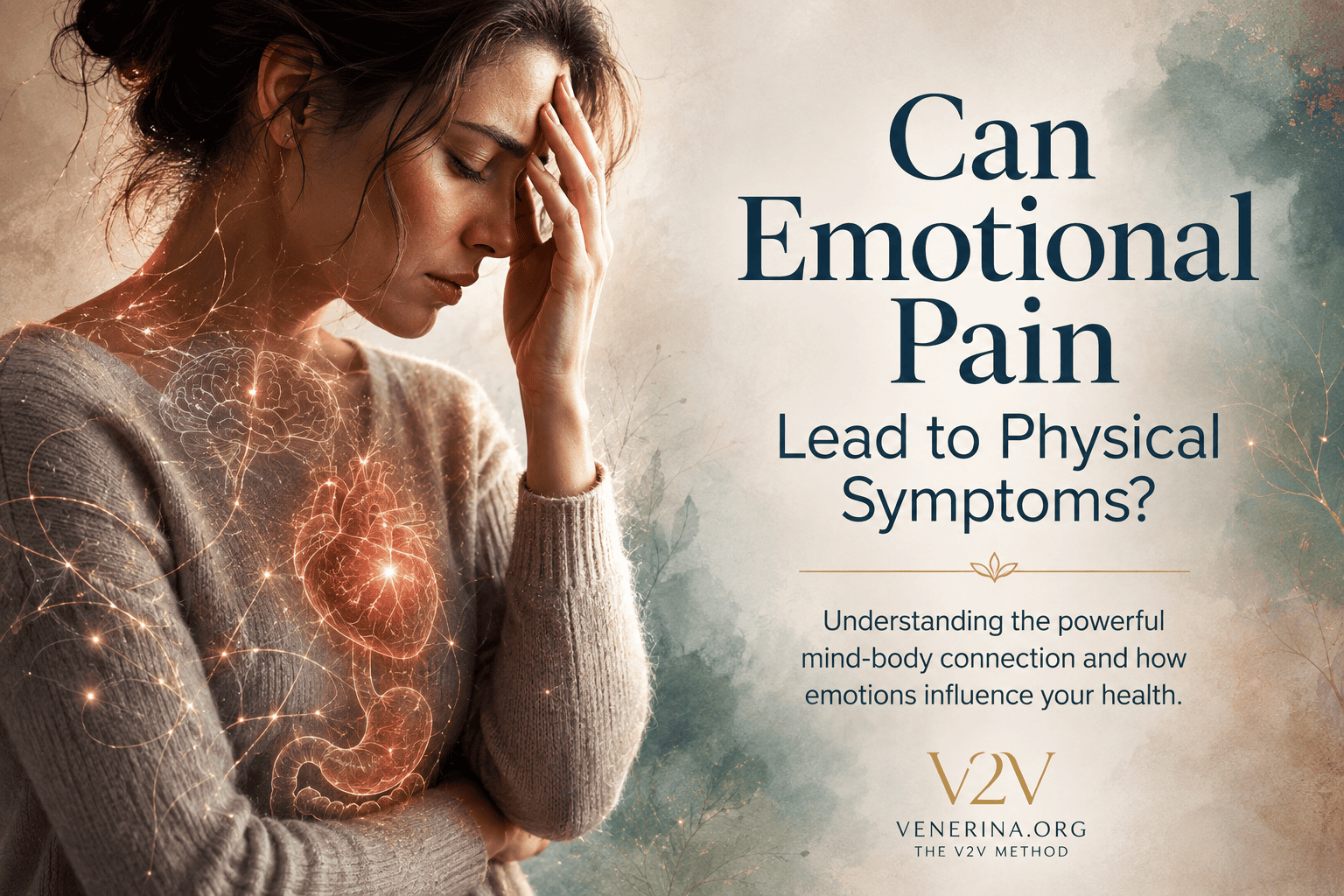
There is a question that continues to appear in doctors’ surgeries, therapy rooms, support groups, and online searches across the world. Can emotional pain lead to physical symptoms? It is a question born not from academic curiosity but from lived experience. People ask it when persistent headaches continue despite normal medical tests, when exhaustion refuses to disappear, when digestive problems seem to worsen during periods of stress, or when muscles ache without any obvious physical injury. They ask it after bereavement leaves them physically depleted, after divorce steals their appetite, or after years of caring for others finally begin to take a visible toll on their health.
For centuries, the relationship between emotional suffering and physical illness occupied an uncertain space between medicine, philosophy, and spirituality. Ancient healing traditions recognised that thoughts and emotions influenced physical well-being, yet these observations often remained outside conventional medical practice. In recent decades, however, scientific research has increasingly confirmed what many cultures have understood intuitively for thousands of years. The mind and body are not separate entities operating independently from one another. They are components of the same interconnected system, continuously exchanging information through the nervous, endocrine, and immune systems.
This relationship occupies a central position in Unlock the Power Within, which explores the influence of thoughts and emotions on health and examines the intricate relationship between the mind, the body, energy, and healing. Entire chapters are dedicated to understanding how emotions affect physical health and how emotional well-being influences every aspect of human functioning.
Yet there is another perspective that deserves equal attention.
In From Victim to Victory, emotional pain is not approached as evidence of weakness, personal failure, or psychological deficiency. Instead, emotional responses are described as intelligent adaptations developed in response to particular circumstances. The book repeatedly challenges the assumption that people are broken and proposes an alternative perspective that has become the foundation of the V2V methodology. Human beings are not broken. They are adapted.
This distinction changes the entire discussion.
When people experience physical symptoms alongside emotional distress, they often assume that one of two explanations must be correct. Either the symptoms are entirely psychological and therefore somehow less real, or they are entirely physical and unrelated to emotions. Unfortunately, this creates a false division that fails to reflect the complexity of the human organism.
Emotional pain does not exist outside the body.
Every emotion produces physiological changes. Fear accelerates the heartbeat and increases alertness. Anxiety affects breathing and digestion. Anger stimulates the release of stress hormones. Grief disrupts sleep, suppresses appetite, and drains energy. Joy influences neurotransmitters associated with pleasure and reward. Even anticipation can alter blood pressure and muscular tension.
The body participates in every emotional experience because emotions are embodied experiences rather than purely intellectual events.
This is why expressions such as “a broken heart,” “a sinking feeling,” “a knot in the stomach,” or “the weight of the world on my shoulders” appear in virtually every culture and language. These expressions are not merely poetic descriptions. They reflect observable physiological sensations.
The heart races during fear. The stomach tightens during anxiety. The chest becomes heavy during grief. The shoulders contract under pressure. The jaw tightens during frustration. The body speaks the language of emotions with remarkable precision.
Modern neuroscience provides a useful framework for understanding why this occurs. The nervous system evolved to prioritise survival. When the brain detects a threat, whether physical or emotional, it immediately begins preparing the body for action. Stress hormones are released. Blood flow is redirected toward major muscle groups. Attention narrows. Digestion slows. Breathing patterns change.
These physiological responses developed to protect our ancestors from immediate danger. In situations involving genuine physical threats, these adaptations are extraordinarily effective.
The difficulty arises because the nervous system does not always distinguish between physical danger and emotional distress. An approaching predator and a devastating financial crisis may activate many of the same physiological mechanisms. A life-threatening situation and prolonged emotional conflict may stimulate similar hormonal responses. A dangerous environment and a deeply painful relationship may produce comparable patterns of hypervigilance.
From a biological perspective, emotional threats are frequently interpreted as survival threats. This understanding lies at the heart of the V2V philosophy.
From Victim to Victory repeatedly emphasises that many emotional patterns represent intelligent responses developed in the service of protection, safety, and survival. Anxiety may represent heightened vigilance learned in an unpredictable environment. Withdrawal may reflect an attempt to remain safe when relationships once felt painful. Overthinking may develop in individuals who learned that mistakes carried significant consequences. Even the feeling of being trapped can emerge when the nervous system remains organised around protection rather than safety.
If emotional responses represent adaptations, then physical symptoms may also be understood differently.
Perhaps the body is not malfunctioning. Perhaps it is communicating. This possibility invites us to reconsider the meaning of symptoms. A headache may not simply be a headache. Fatigue may not simply be tiredness. Digestive problems may not simply be dietary. Muscular tension may not simply be poor posture.
Of course, physical symptoms should never be dismissed or attributed automatically to emotional causes. Proper medical evaluation remains essential. Physical illness requires appropriate diagnosis and treatment. However, recognising the potential contribution of emotional factors allows us to develop a more complete understanding of health.
Consider grief as an example.
Most people expect grief to produce sadness, tears, and emotional vulnerability. Yet anyone who has experienced a significant loss understands that grief affects the entire body. Sleep becomes fragmented. Energy disappears. Concentration deteriorates. Appetite changes. Muscles weaken. Immunity often declines.
Many grieving individuals describe feeling physically ill. This experience should not surprise us. Grief represents one of the most profound forms of physiological disruption a human being can experience. Anxiety offers another powerful example.
People frequently describe anxiety as excessive worrying, but anxiety rarely limits itself to the mind. It often manifests as dizziness, chest discomfort, nausea, digestive disturbances, muscle tension, sweating, palpitations, trembling, and shortness of breath.
Similarly, depression extends far beyond sadness.
From Depression to Power presents an important perspective by suggesting that depression often reflects a response to prolonged strain, loss, disconnection, or emotional exhaustion rather than a personal weakness. The book encourages readers to interpret depression as a signal rather than an enemy.
This interpretation helps explain why depression frequently produces physical symptoms. Exhaustion becomes overwhelming. Movement slows. Sleep changes. Motivation disappears. The body appears heavy. Energy conservation becomes the dominant strategy.
From this perspective, depression can be understood as an adaptive response to prolonged depletion. This principle extends far beyond depression. The human organism constantly adjusts itself according to environmental conditions. When emotional demands persist without resolution, the nervous system gradually alters its baseline state.
Sleep becomes less restorative. Inflammation increases. Recovery becomes slower. Digestion becomes less efficient. Immune function changes. Muscular tension becomes chronic. These adaptations are not evidence of weakness. They represent the body’s attempt to preserve equilibrium under difficult circumstances.
One of the most significant yet frequently overlooked manifestations of emotional pain is chronic muscular tension. Observe people during periods of emotional distress. The shoulders rise. The neck stiffens. The jaw tightens. The fists clench. The breathing becomes shallow. The body contracts.
Now imagine these responses occurring not for minutes or hours, but for months or years. Gradually, tension becomes normal. People become accustomed to waking with headaches. They accept shoulder pain as part of modern life. They assume fatigue is unavoidable. They stop noticing that their breathing remains shallow throughout the day.
Eventually, the distinction between emotional tension and physical tension disappears because they have become inseparable. This phenomenon is particularly important because the nervous system learns through repetition. The more frequently a protective response is activated, the more automatic it becomes.
This process is explored extensively throughout the V2V methodology. Protective adaptations are learned through experience. Avoidance reduces discomfort. Withdrawal reduces vulnerability. Perfectionism reduces criticism.
Emotional numbing reduces overwhelm. Each strategy develops for a reason. The difficulty arises when these strategies continue operating long after the original threat has disappeared. The body continues following old instructions.
From Victim to Victory explains that human beings are living systems capable of change, learning, and renewal. The nervous system can adapt. Emotional patterns can soften. Meanings formed during painful experiences can be reconsidered and understood differently. Healing does not necessarily require becoming someone new. Frequently, it involves reconnecting with aspects of ourselves that were abandoned during periods of survival.
The modern environment often intensifies these difficulties. We live in an era defined by extraordinary levels of stimulation, comparison, and pressure. Information never stops. Expectations continue to rise. Achievement is frequently valued more than meaning, while productivity often takes precedence over well-being.
Under these conditions, many individuals slowly lose contact with their emotional needs.
From Victim to Victory explores how people gradually begin comparing their private emotional experiences with carefully constructed public images of happiness, success, confidence, and achievement. When their emotional reality fails to match these expectations, they frequently conclude that they are inadequate. Over time, this interpretation becomes increasingly difficult to challenge because it begins to feel like truth.
Yet the body continues responding to conditions rather than appearances. It responds to safety. It responds to connection. It responds to rhythm. It responds to rest. It responds to meaning.
When these essential conditions remain absent for prolonged periods, protective adaptations naturally intensify. The V2V model argues that asking a different question can transform the healing process.
Instead of asking, “What is wrong with me?” we might ask, “What happened that required me to adapt in this way?” This subtle shift removes blame and creates space for curiosity. Understanding becomes possible, and understanding represents the first condition necessary for meaningful change.
This approach is profoundly compassionate because it restores dignity to experiences that are often interpreted as personal failures.
Exhaustion is not laziness. Sensitivity is not weakness. Anxiety is not incompetence. Withdrawal is not selfishness. Each response deserves to be understood within the context in which it developed. Perhaps this explains why healing rarely responds to force. People often attempt to fight their symptoms. They suppress emotions. They ignore exhaustion. They criticise themselves for struggling.
Unfortunately, the nervous system does not soften under criticism.
One of the most powerful observations in From Victim to Victory is that genuine healing cannot occur within an atmosphere of self-rejection. The nervous system responds to safety rather than condemnation. Healing emerges through the gradual rebuilding of trust between awareness, memory, emotion, and the body itself.
This process unfolds far more gently than most people expect. Transformation rarely occurs through dramatic revelations. More often, it appears through small recognitions. A reaction becomes less automatic. Anxiety becomes less overwhelming. Rest no longer feels undeserved. A difficult conversation feels less threatening. Moments of peace begin appearing more frequently.
From Victim to Victory describes these subtle changes as evidence that the nervous system is becoming less organised around survival and more organised around safety and choice. Change no longer emerges through force but through understanding.
Can emotional pain lead to physical symptoms? The evidence suggests that it can. The more important question, however, may be whether we are prepared to listen to what our symptoms are trying to communicate. The body is not an obstacle standing in the way of healing. It is an active participant in the healing process.
Symptoms may represent communication rather than betrayal. They may reflect adaptation rather than dysfunction. Most importantly, they may remind us that emotional pain deserves the same compassion, attention, and understanding that we readily offer to physical illness.
The V2V philosophy offers one final insight that fundamentally reshapes this conversation.
You are not broken. You are adapted and what was once necessary for survival can, through awareness, honesty, patience, and self-compassion, become the foundation for transformation and growth.
For further reading:
Why do we store emotions in the body?
To join a retreat in Sicily:

About the author
Venerina Conti is a psychology graduate, holistic health therapist, Reiki Master and author of Unlock the Power Within, From Victim to Victory, From Depression to Power, From Addiction to Freedom and From Stuck to Free. Her work explores the relationship between psychology, emotional healing, the nervous system and personal transformation.