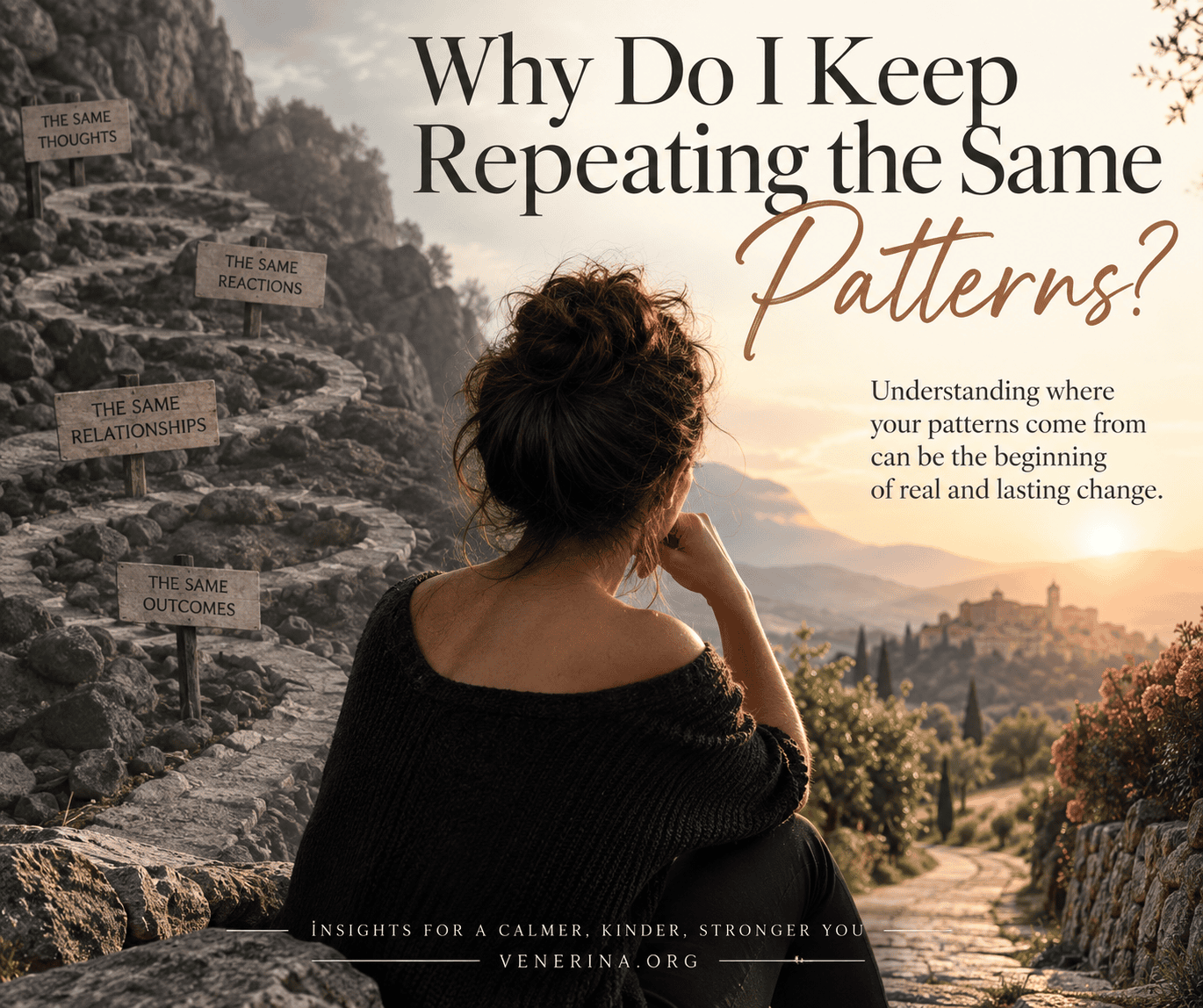
Have you ever found yourself doing something you promised yourself you would never do again? Perhaps you keep choosing the same kind of relationship, reacting in the same way whenever you feel threatened, withdrawing when somebody gets too close, putting things off even though you know they matter, becoming controlling when life feels uncertain, or making the same decisions that leave you disappointed afterwards. The frustrating thing is that you may actually understand yourself very well. You may have spent years reading, reflecting, analysing your childhood, recognising your triggers and trying to understand why you behave the way you do, yet somehow that understanding does not seem to stop you from repeating the same behaviour. Eventually, you may begin to wonder whether there is simply something wrong with you. Why, if you know what you are doing, can you not just change it?
This is a question that lies very close to the heart of my book From Victim to Victory: Why You Feel Broken, How You Heal, and the Path Back to Yourself. The book begins from a different premise to the one we are often given when we struggle with our own behaviour. Rather than immediately asking what is wrong with you, it asks whether there is a possibility that your behaviour once made sense. There is a profound difference between being broken and being adapted. Something that is broken has failed in its purpose; something that has adapted has responded to the conditions it was given. What if some of the patterns you now find frustrating, embarrassing or painful developed because, at some point in your life, they were helping you cope, protect yourself, belong or survive?


Why do we repeat behaviours we already know are hurting us?
Patterns rarely appear out of nowhere. Human beings learn from experience, and particularly from experiences that involve safety, belonging, rejection, uncertainty or emotional pain. If you repeatedly discover that speaking honestly leads to conflict, you may learn to remain quiet. If you grow up needing to pay close attention to other people’s moods, you may become highly vigilant and constantly aware of subtle changes in the people around you. If trusting somebody has repeatedly resulted in disappointment, you may learn to keep people at a distance. If mistakes have carried consequences that felt frightening or overwhelming, you may become someone who needs to think through every possibility before taking action.
At the time, these responses may have been useful. They may have helped you navigate circumstances that you did not have the power, maturity or resources to change. The difficulty often comes later, when your circumstances change but the response remains. You may now be living a completely different life, surrounded by different people and with considerably more understanding than you had when the original pattern developed, yet something inside you continues to respond as though the old circumstances are still present.
This is one of the reasons I describe these patterns as adaptations in From Victim to Victory. The mind is not necessarily working against you when you find yourself behaving in ways you consciously dislike. It may be responding according to what it learned was necessary. Anxiety can develop from vigilance, withdrawal can become a way of protecting yourself from painful connection, and feeling stuck can emerge when a system has spent a very long time operating from protection rather than safety. Understanding this does not minimise the suffering caused by the pattern, nor does it mean that you are not responsible for your behaviour. It simply gives you a different place from which to begin working with it.

Why doesn’t understanding the pattern make it disappear?
This is particularly frustrating when you are someone who is already self-aware. You may be able to explain exactly what you are doing and why you think you are doing it. You might recognise that you become distant when you feel vulnerable, that you become controlling when you are frightened, that you procrastinate when something matters deeply to you, or that you repeatedly choose people who cannot give you the kind of relationship you actually want. You may even have had the same conversation with yourself many times: I know this pattern. I understand where it comes from. So why am I still doing it?
The answer may be that intellectual understanding and lived change are not quite the same thing. You can understand something intellectually while your automatic responses continue to operate according to an older learning. The nervous system does not simply erase an established response because the conscious mind has finally worked out where it came from. Real change usually requires something deeper and more gradual: seeing the pattern clearly, becoming aware of what happens as it begins, creating a little space between the old reaction and the next choice, and repeatedly experiencing the fact that something different is possible. This is one of the reasons the V2V Method begins with Veritas, Seeing Clearly, rather than immediately demanding that you change.
Veritas is about looking beneath the surface and asking what is actually happening rather than immediately judging yourself for what you find. Instead of assuming that a behaviour proves weakness, failure or some fundamental defect in your character, you begin to become curious about its function. What happens immediately before you react? What are you expecting? What are you afraid might happen? What feeling are you trying not to experience? What are you attempting to protect? Once you start asking those questions, the pattern can become much more understandable, and when something becomes understandable it can begin to loosen without requiring you to attack yourself in the process.


Why can something unhealthy still feel familiar?
One of the strangest things about repeating patterns is that what is familiar can sometimes feel safer than what is healthy. We tend to assume that if something makes us unhappy, we will naturally want to move away from it, but human behaviour is not always that straightforward. Familiarity creates a kind of predictability, even when what is familiar is uncomfortable.
If you have spent years being hyper-independent, allowing somebody to help you may initially feel uncomfortable. If you have learned to keep people at a distance, genuine intimacy may make you want to retreat. If you have spent your life anticipating problems, periods of calm may feel strangely unsettling because you are so accustomed to waiting for something to go wrong. If you have always put everybody else’s needs first, saying no can produce guilt even when you know that the boundary is reasonable.
This does not mean that you secretly want to suffer or that you are deliberately choosing unhappiness. It means that your system may have learned a particular way of navigating the world, and changing that way of responding can initially feel unfamiliar. That is why simply telling yourself to stop doing it can be much less effective than understanding what the behaviour has been doing for you.
So how do you actually begin to change a pattern?
Once you have begun to see the pattern clearly, the next question is naturally, What do I do with this understanding? This is where the second stage of the V2V Method, Kinesis, becomes important. Kinesis is where understanding begins to move. It does not demand some dramatic transformation in which you suddenly become a completely different person. In many cases, movement begins in a much quieter way: you notice an old reaction while it is happening, pause before automatically following it, allow yourself to experience an uncomfortable feeling instead of immediately escaping it, or make one small decision differently.
Those moments can seem insignificant, especially when compared with the dramatic transformations we are constantly shown in personal development. They are not insignificant. If your usual response has always been automatic, the moment in which you become aware of it is already different. The pause creates space, and within that space there is the possibility of choice. The book describes Kinesis as a form of movement that is often uncertain and fragile at first rather than powerful and decisive. The intention is not to force change through pressure, because pressure can simply create more of the defensive response you are trying to move beyond. Instead, movement becomes smaller, more deliberate and more sustainable.
Perhaps you pause before sending the angry message. Perhaps you say what you actually feel instead of automatically saying that everything is fine. Perhaps you allow somebody to help you instead of insisting that you can manage everything alone. Perhaps you recognise that familiar urge to withdraw and decide to remain present for another five minutes. Perhaps you make a decision without seeking reassurance from everyone around you. These things may not look particularly dramatic from the outside, but they are important because you are beginning to create new experiences rather than simply repeating the old ones.

Does changing mean becoming someone else?
I think this is another misunderstanding that can make personal growth unnecessarily exhausting. You do not need to become a completely different person in order to change a pattern. The person who developed the pattern was you. The person who learned how to cope was you. The person who found a way through difficult circumstances was you. There is no reason to hate that person simply because some of the strategies that once helped you are no longer serving you particularly well.
The question is whether those adaptations are still necessary.
This is where the third stage of V2V, Valor, becomes important. Valor is not about becoming fearless, permanently confident or somehow immune to pain. It is about developing a steadier way of living in which fear and old defensive responses no longer have to determine the direction of your life. The book describes this as a strength that develops gradually, through repeated experiences of living without constant defence, until the need to protect yourself in the old ways begins to soften.
That takes patience because patterns formed over many years cannot realistically be expected to disappear overnight. One of the ideas I return to throughout From Victim to Victory is that meaningful change is not created through urgency or force. Patterns formed through years of adaptation need repeated experiences of safety, honesty and compassionate awareness before they can begin to change. Slow progress does not necessarily mean that nothing is happening. Sometimes the most important changes are taking place beneath the surface long before you can see their results clearly.


Perhaps the pattern is not who you are
There is a particular phrase that can quietly trap us: “That’s just how I am.” We say it after years of behaving in a particular way, and eventually the behaviour becomes part of our identity. We stop seeing it as something we learned and start seeing it as something we are.
Perhaps you are not simply a cold person. Perhaps you learned to protect yourself from closeness. Perhaps you are not incapable of making decisions. Perhaps you learned that mistakes were dangerous. Perhaps you are not naturally controlling. Perhaps control once gave you a sense of predictability when life felt uncertain. Perhaps you are not destined to sabotage yourself. Perhaps you learned to avoid situations in which disappointment, rejection or failure felt particularly threatening.
None of this means that we should blame everything on the past or use our history as an excuse for behaviour that hurts ourselves or other people. Understanding where a pattern came from does not remove responsibility. It can actually make responsibility more meaningful because we are no longer simply condemning ourselves for what we do; we are beginning to understand what needs to change.
One of the ideas at the heart of moving from victim to victory is that the past may explain how certain patterns developed, but it does not have to decide what happens next. The book describes this as a gradual reclaiming of authorship in your own life through awareness, responsibility and rebuilding trust in your own perception.
So if you keep repeating the same patterns, perhaps the first question does not need to be, “How do I finally get rid of this part of myself?” Perhaps a more useful question is, “What is this pattern trying to protect me from?”
Sit with that question for a while. Look at what happens immediately before the behaviour appears. Notice what you feel in your body, what you expect is about to happen, what you are trying to avoid and what you believe you need to do in order to feel safe. You may begin to discover that the behaviour you have been fighting has a history, a purpose and a logic of its own.
That is where Veritas begins: seeing clearly without immediately judging what you see. From there comes Kinesis, the willingness to create movement through small, conscious choices rather than trying to force yourself into transformation. Over time, those experiences can begin to develop into Valor, the steadiness that allows you to live with greater freedom rather than remaining permanently organised around defence.
Perhaps the most important thing you discover along the way is that the part of you you have spent years trying to defeat was never actually your enemy. It was trying to help you in the only way it knew how at the time. The work now is not to punish that part of yourself, but to understand it, thank it for what it tried to do, and begin teaching yourself that life may require something different now.
That is why I wrote From Victim to Victory: Why You Feel Broken, How You Heal, and the Path Back to Yourself. It is not about pretending that painful experiences did not happen, nor is it about demanding that you transform yourself into somebody you are not. It is about looking at the patterns that have shaped your life with enough honesty and compassion to ask whether they still need to control it.
Because perhaps the question is not, “Why do I keep repeating the same patterns?”
Perhaps the deeper question is “What did this pattern once help me survive, and what might I be ready to learn now?”
That is where change can begin.