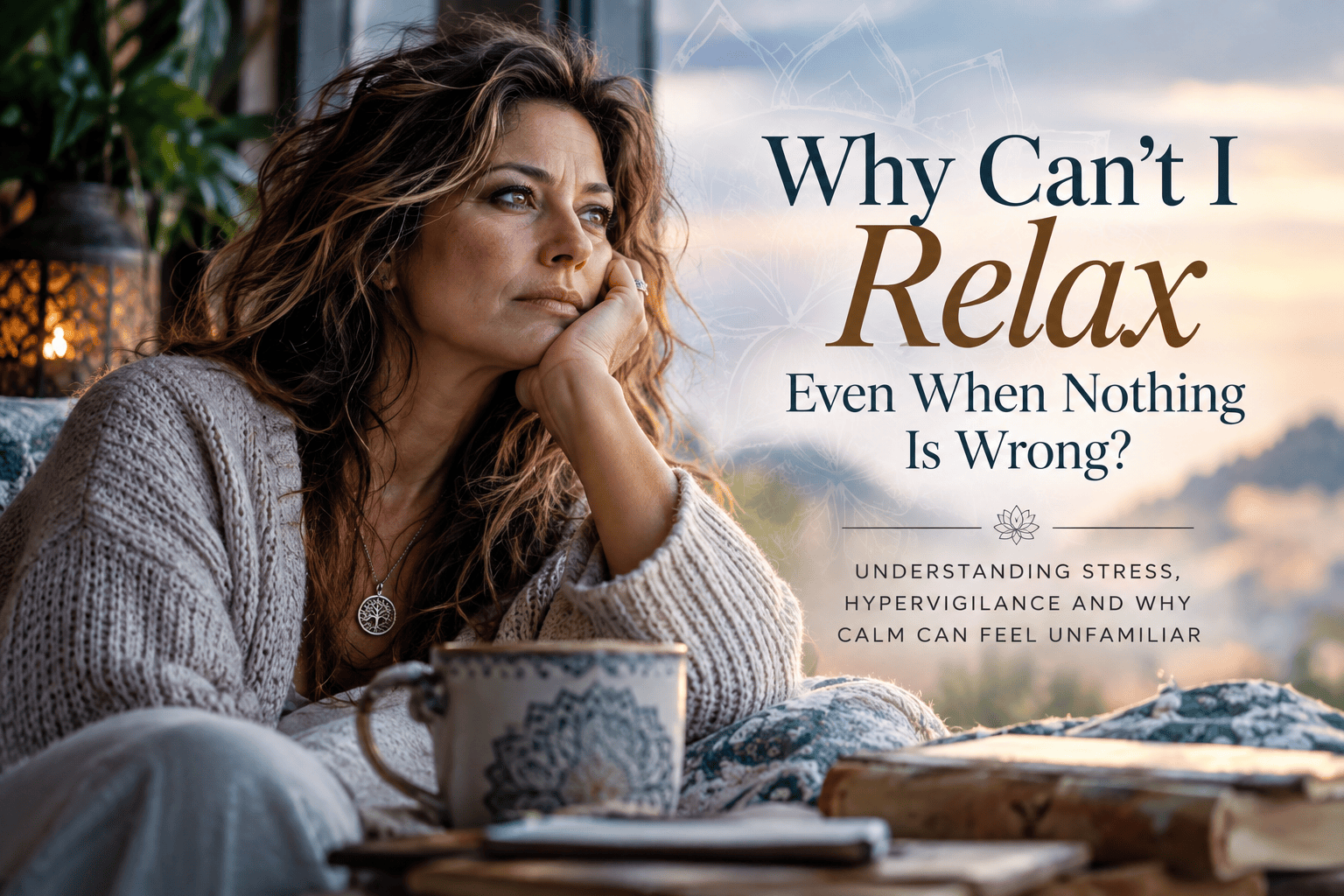
Why Can’t I Relax Even When Nothing Is Wrong? This is a question that many people ask themselves, sometimes with genuine bewilderment. It is a strange experience because, logically, everything may appear to be fine. There is no immediate crisis, no urgent deadline, no obvious threat and perhaps nothing in your life that you can point to and say, “That is the reason I feel this way.” You may even have deliberately created time to rest, only to discover that when you finally sit down, your mind becomes busier rather than quieter. You think about what you need to do tomorrow, remember something you forgot to do yesterday, begin mentally organising the week ahead, check your phone, notice something that needs cleaning or sorting, or suddenly feel an inexplicable urge to get up and do something. Your body may be tense, your shoulders raised, your jaw tight or your breathing shallower than usual, while your mind continues looking for the next thing that requires your attention.
The most confusing part is often the apparent contradiction between what you know and what you feel. You know you are safe, yet you do not feel entirely safe. You know there is nothing you need to deal with immediately, yet you cannot quite switch off. You may even become frustrated with yourself because relaxation seems as though it should be one of the easiest things in the world. After all, if there is nothing wrong, why can’t you simply relax?
Sometimes the answer lies not in what is happening in your life now, but in what your mind and body have learned to expect.
This is a subject I return to repeatedly in my work and in my books because it sits beneath many experiences that people tend to regard as separate problems. Anxiety, hypervigilance, the need for control, overthinking, emotional exhaustion, difficulty resting and the feeling that you must always be doing something can appear to be entirely different issues. Yet sometimes they are different expressions of the same underlying adaptation: a system that has learned that remaining alert is safer than letting go.


In From Victim to Victory, I explore the idea that many of the responses people experience as evidence that something is wrong with them may actually be adaptations to what they have lived through. The nervous system learns from experience. It learns what to anticipate, what to avoid, what needs to be controlled and what needs to be protected. Over time, those responses can become so familiar that they begin to feel like personality. A person may believe that they are simply anxious, controlling, overly sensitive or incapable of relaxing, without recognising that these characteristics may have developed as ways of responding to circumstances in which uncertainty, safety or emotional connection once felt fragile. From Victim to Victory – Book 1…
That distinction is important because if you believe that something is simply “who you are”, you are far less likely to believe that it can change. If, however, you begin to recognise that some of your reactions may be learned adaptations, another possibility appears. What has been learned can, under the right conditions, be learned differently.
This does not mean that everyone who struggles to relax has experienced trauma, nor does it mean that there must be some dramatic event hidden somewhere in their past. Human beings can become accustomed to tension for many reasons. Years of responsibility, emotional uncertainty, difficult relationships, unpredictable environments, pressure to perform, financial worries, caring for other people, perfectionism, chronic stress or simply living for a long time without enough genuine rest can all contribute to a pattern in which being alert becomes normal. Sometimes we do not even recognise that we have been living in a state of tension because we have lived that way for so long.
And that is where the question becomes much more interesting. Instead of asking only, “Why can’t I relax?”, perhaps we should sometimes ask, “What has my system learned about what happens when I stop?”
That question takes us away from self-criticism and towards curiosity.

When being busy becomes a way of feeling safe
There are people who are exceptionally capable. They organise everything, remember everything, anticipate problems before they happen and seem to function remarkably well under pressure. They are often the people others depend upon because they are reliable, practical and capable of taking control when something goes wrong. From the outside, this may look like nothing more than a strong personality and excellent organisational skills, and sometimes that is exactly what it is.
But there are occasions when constant activity has another function.
For some people, being busy is not simply something they enjoy. It is a way of avoiding the discomfort that emerges when there is nothing left to do. As long as there is another task, another problem, another person to help or another responsibility to manage, attention remains directed outwards. There is less space to notice what is happening internally. The moment everything becomes quiet, however, the thoughts and feelings that were being held at bay may suddenly become much more noticeable.
I know something about this myself. My life has involved an enormous amount of movement, responsibility, work, travel, study, volunteering and caring for other people. I have travelled through more than forty countries, lived and worked in very different environments, volunteered in emergency and disaster situations, and spent years observing human behaviour across cultures and circumstances. My academic background in psychology and transpersonal studies has obviously contributed to the way I understand people, but much of what I have learned has also come from living, observing and, sometimes rather unwillingly, using myself as my own laboratory.
I have also experienced PTSD and depression, and having to work through those experiences changed the way I understood psychological suffering. There is a significant difference between reading about a response intellectually and discovering what it feels like when your own mind and body are doing something you cannot simply order them to stop doing. That experience made me much more interested in the question of why a person responds in a particular way rather than simply asking how to eliminate the response.
It is entirely possible to be extraordinarily capable while being internally exhausted. You can run a business, raise a family, care for other people, solve problems, organise holidays, manage crises and keep functioning while your internal system is working much harder than anybody around you realises. Competence and regulation are not the same thing. Someone can look calm and capable while experiencing considerable internal activation.
This is one of the reasons that I am cautious about defining people by their behaviours. A person who appears controlling may be trying to create a sense of safety. A person who cannot sit still may have become accustomed to using activity to manage discomfort. A person who is constantly prepared for the worst may have learned, somewhere along the way, that being unprepared carries a cost.
When we see only the behaviour, we can easily miss the function underneath it.


Why does everything seem louder when you finally stop?
One of the peculiar things about chronic stress is that people often do not realise how activated they are while they are busy. They may move through their day perfectly efficiently, completing tasks, talking to people, working, shopping, driving and dealing with whatever needs to be dealt with. Then, when they finally stop, the tension becomes much more obvious.
Suddenly the mind seems to have something to say about everything.
You may remember an unfinished task, begin worrying about a conversation you had earlier, think about something that could go wrong next week or start mentally planning how you are going to deal with a problem that has not even happened yet. You may become aware of physical tension that you had not noticed while you were occupied. Perhaps you realise that you have been clenching your jaw or holding your shoulders tightly for hours.
It is tempting to conclude that the problem is simply that you think too much. Sometimes, however, the relationship between the body and the mind may be more complicated than that. When the nervous system is activated, the mind naturally attempts to interpret that state. If the body feels as though something requires attention, the brain may begin searching for an explanation. A thought appears, then another, and another, and soon there seems to be an endless stream of things to worry about.
This is one reason why telling yourself to “stop thinking” is rarely a particularly useful strategy. You are not dealing with a computer that has been left running and can simply be switched off. Your psychological and physiological processes are interconnected.
In Fear Is Not the Enemy, I explore the difference between understanding intellectually that you are safe and actually experiencing that safety within the body. A person may recognise that the present situation is not dangerous and yet continue to experience a learned state of vigilance. The fact that the original circumstances have changed does not necessarily mean that every physiological pattern changes at exactly the same moment. The body may need repeated experiences of a different kind of experience before the new state becomes familiar. Fear is not the Enemy
This is why someone can genuinely say, “I know everything is fine, so why don’t I feel fine?” Knowing and feeling do not always travel at the same speed.

When calm becomes unfamiliar
Perhaps the most interesting aspect of this subject is that some people do not simply struggle to relax; they find relaxation uncomfortable.
They may go on holiday and spend the first few days feeling restless. They may have an empty afternoon and feel compelled to fill it. They may sit down to meditate only to discover that their thoughts seem to become louder. They may have a rare evening without responsibilities and somehow end up cleaning the kitchen, reorganising a cupboard or checking their emails.
Then they may conclude that they are simply “not good at relaxing”. What if the problem is not an inability to relax? What if calm has simply become unfamiliar?
This is an important distinction because human beings tend to gravitate towards what is familiar, and familiarity can be surprisingly powerful. If tension, responsibility, anticipation and constant activity have been part of your life for years, then that state may feel normal even if it is exhausting. You know how to function there. You know what to expect. You know what to do. Calm is different.
If you are accustomed to looking for the next problem, a period in which there is no problem to solve can feel strangely empty. If you are accustomed to monitoring other people’s needs, having nobody to look after can feel uncomfortable. If your sense of worth has become closely connected with productivity, doing nothing may trigger guilt.
The nervous system is not necessarily saying, “Calm is dangerous.” It may simply be responding to something unfamiliar.
This idea is central to the way I approach emotional patterns. In From Victim to Victory, I describe how repetition can strengthen responses until what was once an adaptation becomes so familiar that it begins to resemble personality. Hypervigilance can look like anxiety, but it can also be understood as attention that has become trained by unpredictability. The need for control can be understood not simply as rigidity, but as an attempt to create safety where safety once felt uncertain.
When we understand the function, our relationship with the pattern can begin to change.


What if your hypervigilance once made sense?
This is where the first stage of the V2V Method, Veritas, becomes particularly relevant.
Veritas means truth, but the truth I am interested in is not a weapon with which we attack ourselves. It is a willingness to look honestly at what is happening beneath the surface of our thoughts, emotions and reactions. Rather than beginning with the assumption that something is wrong with us, we ask what is actually happening and why.
That distinction may sound subtle, but psychologically it can be enormous.
If I say, “I am an anxious person,” I have turned a response into an identity. If I ask, “What has taught me to anticipate danger so quickly?” I have opened a door.
If I say, “I am controlling,” I have given myself a label. If I ask, “What happens inside me when I cannot control the outcome?” I have begun investigating the mechanism.
If I say, “I cannot relax,” I have defined myself by the problem. If I ask, “What do I experience when I stop being busy?” I am beginning to understand the experience itself.
And perhaps the most useful question of all is, “What do I believe might happen if I let my guard down?”
For one person, the answer might be that they are afraid they will miss something important. For another, it might be that they associate rest with laziness. Someone else may have learned that other people’s needs always come first, while another person may have spent so many years anticipating problems that uncertainty itself now feels intolerable.
There may be a very specific history behind the pattern, or there may be a combination of experiences accumulated over many years. There does not always have to be one dramatic explanation.
The purpose of understanding is not to find someone or something to blame. It is to restore context.
As I wrote in From Victim to Victory, when we begin to understand protective responses in terms of adaptation rather than personal failure, the internal relationship with ourselves can change. Instead of fighting the mechanism that once tried to protect us, we can begin to understand it. From Victim to Victory – Book 1…
That is where change becomes possible.
You cannot bully yourself into feeling safe
One of the things I find particularly counterproductive is the way people sometimes respond to their own distress by becoming even more demanding of themselves.
Why can’t I calm down?
Why am I still worrying?
I should be over this by now.
Other people manage perfectly well.
Just relax.
There is an obvious irony in telling an already tense nervous system that it is failing at relaxation. The original activation now has another layer placed on top of it: self-judgment. You are tense, and you are angry with yourself for being tense. You are worried, and then you become worried about the fact that you are worrying. You cannot relax, and then you turn relaxation into another performance that you are expected to succeed at. This is one reason I believe compassion is not something separate from psychological change. It is part of the environment in which change becomes possible.
Understanding a response does not mean approving of everything we do. It does not mean remaining trapped in a pattern because “that’s just how I am”. It means recognising that if a behaviour or response developed for a reason, attacking yourself for having it may not be the most effective way to change it.
The nervous system does not necessarily become more settled because we are furious with it. In fact, the movement away from accusation and towards understanding is central to Veritas. The purpose is not endless analysis of the past. It is to understand enough of the pattern that we no longer have to fight ourselves in order to change.
Learning to rest is different from forcing yourself to relax
If you have spent years living in a state of tension, you may not be able to move immediately from constant vigilance into deep tranquillity simply because you have decided that it is time to relax. The expectation that you should be able to do so can actually become another source of pressure.
Real change is often considerably less dramatic.
It may begin by noticing that your shoulders are tense. It may begin by recognising that you automatically reach for your phone whenever there is silence. It may begin by allowing yourself to finish one task before mentally moving on to five others. It may begin by noticing the urge to become busy and becoming curious about what you are trying not to feel.
These moments can seem almost ridiculously small, but that does not make them insignificant.
One of the themes I explore in Fear Is Not the Enemy is that after long periods of vigilance, moments of ease may initially be brief. The fact that they are brief does not mean they are meaningless. They can be evidence that the capacity for balance has not disappeared. The system can still learn. Fear is not the Enemy
That is an important message because people often expect healing to feel dramatic. They imagine that one day they will suddenly wake up and discover that they are completely calm, fearless and transformed.
Real psychological change is usually much less theatrical.
Sometimes it is simply the first moment in years when you realise that you have been sitting quietly for ten minutes and nothing terrible happened.
Sometimes self-improvement becomes another form of pressure
There is another aspect of modern life that I think we need to examine honestly. We have become very good at turning everything into a project. We don’t simply rest; we optimise our rest. We don’t simply sleep; we monitor our sleep. We don’t simply exercise; we count everything. We don’t simply meditate; we measure how long we have meditated. Even relaxation can become another thing we believe we are supposed to perform correctly.
For some people, this creates an extraordinary paradox. They are exhausted because they are constantly trying to become healthier, calmer, more productive, more successful and more psychologically balanced. At some point, perhaps we have to stop asking ourselves what we should be doing better. Perhaps we need to ask what it would feel like simply to be.
This can be particularly challenging for people whose identity has become closely connected with competence. If you have spent decades being the person who solves problems, looks after others, keeps things moving and copes with whatever life throws at you, then doing nothing can feel strangely vulnerable.
It can raise questions that are much deeper than relaxation.
Who am I when I am not being useful?
Who am I when nobody needs anything from me?
Who am I when there is nothing to fix?
Who am I when I am not performing?
These are not merely questions about stress management. They are questions about identity.
What happens when the guard begins to soften?
Healing does not mean that you will never feel anxious again. It does not mean that difficult circumstances will stop affecting you or that fear will disappear from your life. Being human involves activation, uncertainty, grief, excitement, stress and change.
The goal is not to become a person who never feels anything uncomfortable. It is to develop a different relationship with what you feel. In Fear Is Not the Enemy, I explore the difference between healing from fear and learning to live beyond survival. Fear may still arise, but it does not necessarily have to occupy the whole of our awareness. As vigilance softens, some of the energy that was previously devoted to constant readiness becomes available for other aspects of life. Fear is not the Enemy
That energy might go towards creativity, relationships, curiosity, pleasure, meaningful work or simply being present enough to notice that life is actually happening while you are busy preparing for it. This, for me, is a much more useful understanding of r elaxation. Relaxation is not necessarily the absence of difficult thoughts. It is the growing ability to experience the present without continually preparing yourself for an imagined future.
Sometimes we don’t need to find the problem
So, if you are someone who keeps asking, “Why can’t I relax even when nothing is wrong?”, perhaps the answer is not that you are defective, difficult or incapable of enjoying life.
Perhaps your system has simply become very good at protecting you. Perhaps it learned that vigilance was useful. Perhaps it learned that being prepared was safer than being surprised. Perhaps it learned that being busy kept difficult feelings at a manageable distance. Perhaps it learned that control created an illusion of certainty in circumstances where certainty was not available. Or perhaps you have simply been carrying too much for too long.
Whatever the explanation, the first step does not have to be forcing yourself to change. It can be understanding. That is why I return so often to Veritas. Before we can transform a pattern, we need to see it clearly. We need to stop asking only, “What is wrong with me?” and become willing to ask, “What is happening here?”
Sometimes what feels like a personality trait is an adaptation. Sometimes what feels like weakness is a nervous system that has become exceptionally practised at protection. Sometimes what looks like overthinking is a mind attempting to make sense of a body that remains on alert.
Sometimes the thing we call “not being able to relax” is simply a body that has not yet fully learned that it is allowed to stop. The important word there is yet because a learned response is not necessarily a permanent response.
My work through the V2V Method is based on precisely this possibility: that understanding our emotional patterns, nervous-system responses and identity conditioning can create the foundation for meaningful change. From Stuck to Freeexplores the same broader principle from another direction, looking at the beliefs and learned patterns that can leave us feeling trapped and at the possibility of moving beyond them through understanding rather than self-condemnation. From Stuck to Free Final(1)
So perhaps, the next time you finally have a quiet evening and discover that you cannot quite settle, you could resist the temptation to become annoyed with yourself. Instead, become curious. Notice what happens when you stop. Notice what your mind immediately starts doing. Notice what your body does. Notice whether stillness feels peaceful, uncomfortable, boring, vulnerable or strangely unsafe. Then ask yourself, gently rather than critically: What has my system learned about what happens when I let my guard down?
You may not have an immediate answer, and you do not need one. Sometimes healing begins not when we finally find the perfect explanation, but when we stop treating our own reactions as evidence that something is wrong with us. Sometimes we don’t need to find the problem.
We need to understand why our body is still looking for one.
And perhaps, little by little, through understanding rather than force, we can teach ourselves something that may have become unfamiliar: that there are moments when nothing needs fixing, nobody needs rescuing, nothing needs anticipating and nothing needs proving. There are moments when we are allowed simply to be where we are and perhaps that is where real rest begins.